
What happens to animals that have been used in research?
In Australia, thousands of animals are used each year in research. At the end of their “use” they are usually killed – even if healthy. Those that survive are passed on for use in more research experiments.
The only exception to this is in NSW, where healthy dogs and cats may be rehomed after three years in research.
In February 2021, Animal Justice Party MP Andy Meddick addressed the Victorian Parliament calling for it to be made mandatory for dogs and cats used in laboratories to be rehabilitated and rehomed. A month later, Minister for Agriculture Mary-Anne Thomas announced a new Taskforce on Rehoming Pets. Part of the remit of the taskforce was increasing rehoming of dogs and cats used in research with the following themes identified:
- how to improve information and advice for scientific organisations and animal ethics committees to support the successful rehoming of dogs and cats used in research and teaching.
- how to further develop and implement the successful rehoming of dogs and cats used in research and teaching.
AFSA submitted a comprehensive submission to the taskforce and reinforced the limited transparency in animal research as a barrier to achieving the above. In December 2021, after extensive consultation with the pet rehoming and animal welfare sectors, the Taskforce delivered its final report to Government with 17 recommendations. After reviewing the taskforce recommendations, the Victorian Government announced its support for all the recommendations and allocated funding for implementation.
Yet, despite this announcement, the Victorian Government has not committed to any of these recommendations, will not be mandating the Right to Release, or provide any funding for rehoming.
In February 2021, Animal Justice Party MP Andy Meddick addressed the Victorian Parliament calling for it to be made mandatory for dogs and cats used in laboratories to be rehabilitated and rehomed. A month later, Minister for Agriculture Mary-Anne Thomas announced a new Taskforce on Rehoming Pets. Part of the remit of the taskforce was increasing rehoming of dogs and cats used in research with the following themes identified:
- how to improve information and advice for scientific organisations and animal ethics committees to support the successful rehoming of dogs and cats used in research and teaching.
- how to further develop and implement the successful rehoming of dogs and cats used in research and teaching.
AFSA submitted a comprehensive submission to the taskforce and reinforced the limited transparency in animal research as a barrier to achieving the above. In December 2021, after extensive consultation with the pet rehoming and animal welfare sectors, the Taskforce delivered its final report to Government with 17 recommendations. After reviewing the taskforce recommendations, the Victorian Government announced its support for all the recommendations and allocated funding for implementation.
Yet, despite this announcement, the Victorian Government has not committed to any of these recommendations, will not be mandating the Right to Release, or provide any funding for rehoming.
NSW has finally made the release of cats and dogs mandatory after their use in research. They have also implemented a system to ensure animals are not kept in research for longer than 3 years.
The Animal Research Amendment (Right to Release) Act 2022 was put into place in November 2022. In July 2024, the NSW Government announced the Research Animals Rehoming Grant Program to support animal rehoming groups, and announced three grants in February 2025.
Animals should be rehomed
We believe that animals in research deserve the opportunity to live out their lives in health, safety and happiness. We are working closely with Beagle Freedom Australia and the Animal Justice Party to implement legislation to make this happen.
In 2013 the Australian code for the care and use of animals for scientific purposes was updated and the following clause was inserted:
“Opportunities to rehome animals should be considered wherever possible, especially when the impact of the project or activity on the wellbeing of the animal has been minimal and their physiological condition and behavioural attributes indicate that they can be introduced to a new environment with minimal, transient impact on their wellbeing.”
However, this clause is not legally robust. Under this clause, an Animal Ethics Committee needs to only consider rehoming of an animal, but there is no legal requirement for them to actually do so.
The Right to Release campaign focuses on dogs and cats, yet all healthy animals – no matter small – should have the same opportunity. A recent paper put forward the ethical case for this:
We conclude that there are no good reasons to discriminate between rats, mice, chickens, dogs, cats, pigs, horses, fishes, frogs, snakes and non-human primates. Why put an effort into rehoming dogs and cats, while routinely killing redundant mice and rats? We should offer all redundant laboratory animals a longer life in good welfare, if possible (see also: [39]). The life of any healthy animal of a sentient species is worth the relatively small effort.
Act NOW - Sign the Petition
For this Right to Release bill to pass we need public support. Please help us – sign the petition now from your state or territory below:
Australia lags behind other countries
In several states in the USA, the Beagle Freedom Bill has been passed. This means that all tax-payer funded labs must offer their dogs and cats up for adoption through animal rescue organisations, instead of just killing them as the standard procedure. It may soon even become Federal law!
Successful rehoming story
Leo spent the first part of his life enduring horribly invasive vision procedures, before being adopted by a loving family in Melbourne. Leo quickly became a happy and affectionate cat who enjoyed the company of his human companions for the 13 years of freedom he enjoyed after being released from research. A great testament to the ability of animals to forgive the past when they are treated with kindness and compassion. Read Leo’s story here.




Adopt or Foster an animal used in research
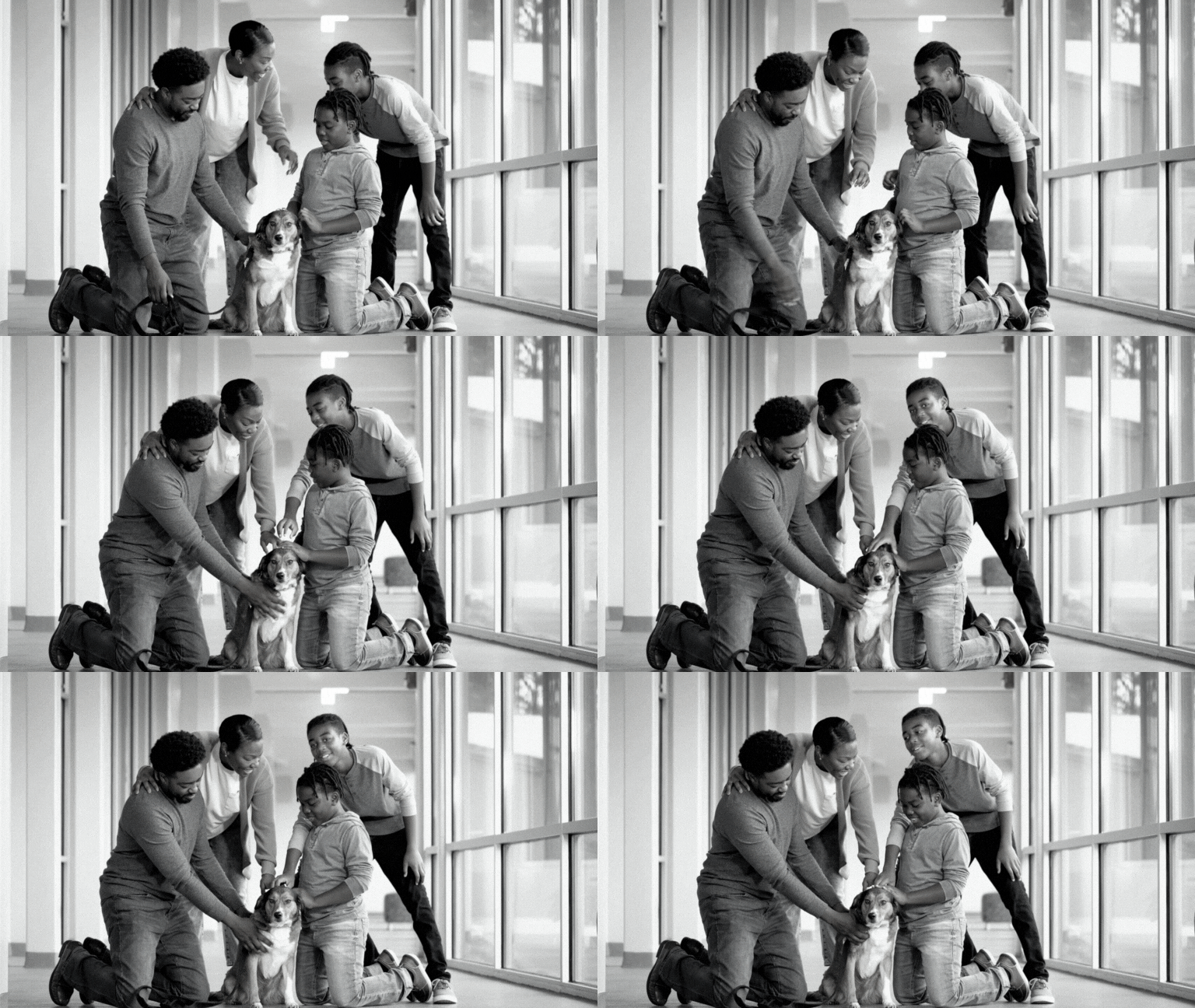
There are two organisations in Australia currently working to rehome animals from research. From rabbits and guinea pigs to dogs and cats, you can completely transform their lives simply by giving them a safe and loving home. There are several other organisations around the world also doing this work.